The bogus government is grossly disgraced in the outside world

A strong sentiment! The Pakistani government’s reputation has indeed been impacted by various factors, including concerns over human rights, corruption, and governance.These issues have attracted international attention and criticism, affecting the country’s image abroad.Some specific incidents and issues that may have contributed to this perception include.Human rights concerns.Allegations of human rights abuses, particularly in Balochistan and Kashmir, have drawn international criticism.Corruption Corruption remains a significant challenge in Pakistan, with the country ranking 140 out of 180 in Transparency International’s 2021 Corruption Perceptions Index.Governance issues.Concerns over the rule of law, judicial independence,judicial independence, and the influence of the military on politics have also impacted the government’s reputation.These challenges have led to increased scrutiny from the international community, including.UN reports The United Nations has published reports highlighting human rights concerns and other issues in Pakistan.Western criticism Western countries, including the United States and the United Kingdom, have expressed concerns over Pakistan’s human rights record and governance.Media coverage International media outlets have reported on various issues in Pakistan, contributing to a negative perception of the government.To address these challenges and improve its reputation, the Pakistani government must prioritize governance reforms, human rights protection, and transparency.

By: Masood Hussain Geffery

Special thanks for International News Network
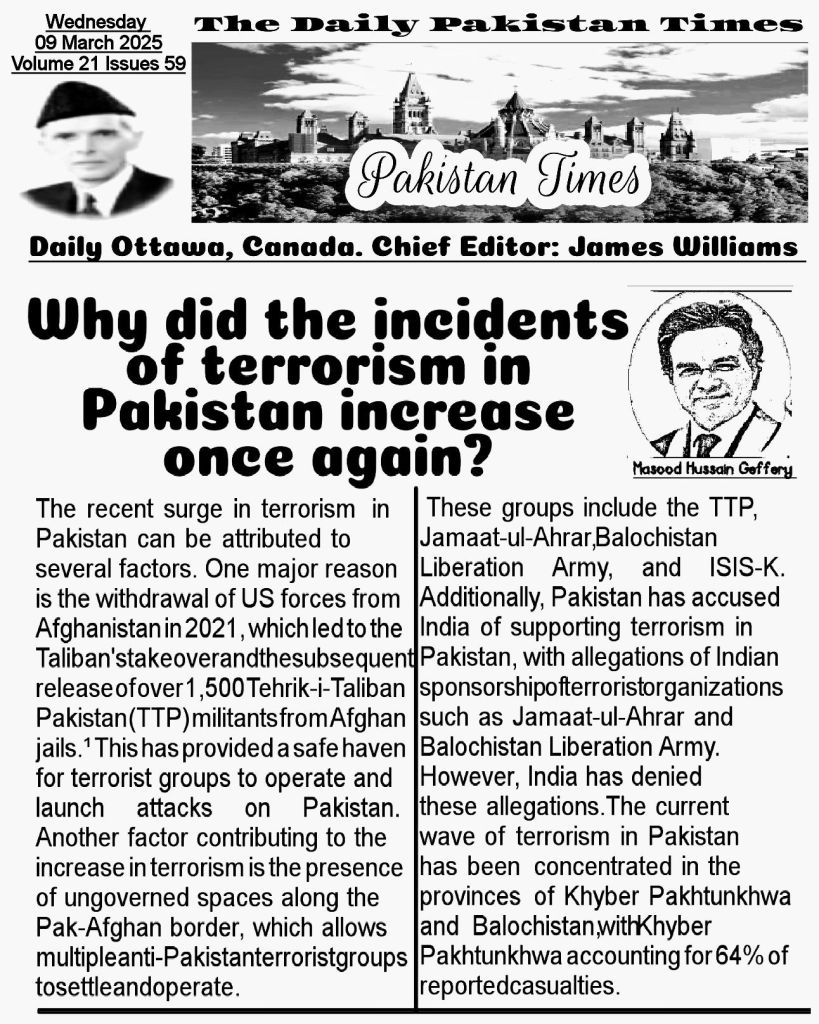
Why did the incidents of terrorism in Pakistan increase once again?

The recent surge in terrorism in Pakistan can be attributed to several factors. One major reason is the withdrawal of US forces from Afghanistan in 2021, which led to the Taliban’s takeover and the subsequent release of over 1,500 Tehrik-i-Taliban Pakistan (TTP) militants from Afghan jails. This has provided a safe haven for terrorist groups to operate and launch attacks on Pakistan.


Another factor contributing to the increase in terrorism is the presence of ungoverned spaces along the Pak-Afghan border, which allows multiple anti-Pakistan terrorist groups to settle and operate. These groups include the TTP, Jamaat-ul-Ahrar, Balochistan Liberation Army, and ISIS-K.


Additionally, Pakistan has accused India of supporting terrorism in Pakistan, with allegations of Indian sponsorship of terrorist organizations such as Jamaat-ul-Ahrar and Balochistan Liberation Army. However, India has denied these allegations.


The current wave of terrorism in Pakistan has been concentrated in the provinces of Khyber Pakhtunkhwa and Balochistan, with Khyber Pakhtunkhwa accounting for 64% of reported casualties.


Special thanks for 
The Daily Pakistan Times. Ottawa (Canada).
Prof Masood Hussain Geffery

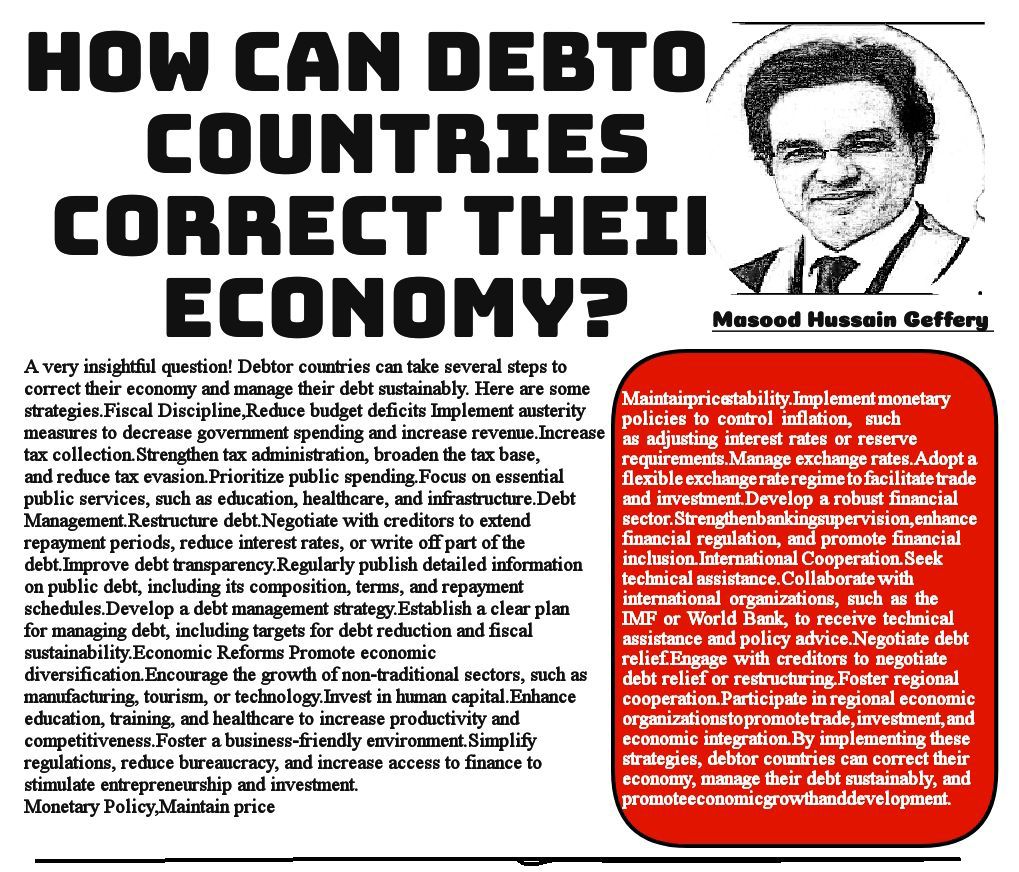
How can debtor countries correct their economy?

By: Masood Hussain Geffery. Debtor countries can take several steps to correct their economy and manage their debt sustainably. Here are some strategies:

Fiscal Discipline

  1. Reduce budget deficits: Implement austerity measures to decrease government spending and increase revenue.
  2. Increase tax collection: Strengthen tax administration, broaden the tax base, and reduce tax evasion.
  3. Prioritize public spending: Focus on essential public services, such as education, healthcare, and infrastructure.

Debt Management

  1. Restructure debt: Negotiate with creditors to extend repayment periods, reduce interest rates, or write off part of the debt.
  2. Improve debt transparency: Regularly publish detailed information on public debt, including its composition, terms, and repayment schedules.
  3. Develop a debt management strategy: Establish a clear plan for managing debt, including targets for debt reduction and fiscal sustainability.

Economic Reforms

  1. Promote economic diversification: Encourage the growth of non-traditional sectors, such as manufacturing, tourism, or technology.
  2. Invest in human capital: Enhance education, training, and healthcare to increase productivity and competitiveness.
  3. Foster a business-friendly environment: Simplify regulations, reduce bureaucracy, and increase access to finance to stimulate entrepreneurship and investment.

Monetary Policy

  1. Maintain price stability: Implement monetary policies to control inflation, such as adjusting interest rates or reserve requirements.
  2. Manage exchange rates: Adopt a flexible exchange rate regime to facilitate trade and investment.
  3. Develop a robust financial sector: Strengthen banking supervision, enhance financial regulation, and promote financial inclusion.

International Cooperation

  1. Seek technical assistance: Collaborate with international organizations, such as the IMF or World Bank, to receive technical assistance and policy advice.
  2. Negotiate debt relief: Engage with creditors to negotiate debt relief or restructuring.
  3. Foster regional cooperation: Participate in regional economic organizations to promote trade, investment, and economic integration.

By implementing these strategies, debtor countries can correct their economy, manage their debt sustainably, and promote economic growth and development.

Destroys it’s own country

By: Masood Hussain Geffery

A government can destroy its own country through a combination of policies, actions, and inactions that undermine the nation’s economic, social, and political stability. This can include:

  • Corruption and mismanagement, leading to economic stagnation and inequality
  • Suppression of political opposition and dissent, resulting in social unrest and human rights violations
  • Misallocation of resources, prioritizing military spending or pet projects over essential public services and infrastructure
  • Ignoring or exacerbating environmental degradation and climate change
  • Implementing harmful economic policies, such as printing excessive money, leading to hyperinflation
  • Fostering divisions and sectarianism, creating social and ethnic tensions
  • Neglecting education, healthcare, and social welfare, exacerbating poverty and inequality
  • Alienating international partners and allies, leading to diplomatic isolation and economic sanctions

These factors can culminate in widespread suffering, political instability, and even state collapse, ultimately destroying the country.

Relationship between US and Iran

By: Masood Hussain Geffery

Here are some key points about the relationship between the U.S. and Iran ¹ ² ³ ⁴ ⁵:

  • Since 1980, the United States and Iran have had no formal diplomatic relations.
  • Iran and the United States have a tumultuous history, including the CIA-backed coup in Iran in 1953, the Iran hostage crisis in 1979 and the U.S. drone strike that killed top Iranian military commander Qassem Soleimani in 2020.
  • The United States attributes the worsening of relations to the Iran hostage crisis, human rights abuses, Iran’s anti-Western ideology and its nuclear program.
  • Iran has said that the natural conflict between the Islamic system and the oppressive power of the U.S. is to blame for the poor relationship, as well as U.S. support for Israel.
  • In 2015, the United States led successful negotiations for a nuclear deal, the Joint Comprehensive Plan of Action, which placed substantial limits on Iran’s nuclear program.
  • In 2018, the Trump administration withdrew from the nuclear deal and re-imposed sanctions, initiating the “maximum pressure campaign” against Iran.

Is Pakistan able to climate change ?

By: Masood Hussain Geffery

Pakistan is vulnerable to climate change due to its geography and economic conditions. Here’s a snapshot of Pakistan’s understanding and response to climate change:

Understanding Climate Change

  1. Awareness: Pakistan has made progress in raising awareness about climate change, with various government departments, NGOs, and media outlets actively promoting climate education.
  2. Research and development: Pakistani research institutions and universities are conducting studies on climate change impacts, vulnerability, and adaptation.
  3. Climate policy framework: Pakistan has established a climate policy framework, including the National Climate Change Policy (2012) and the Nationally Determined Contributions (NDCs) under the Paris Agreement.

Climate Change Impacts in Pakistan

  1. Extreme weather events: Pakistan is prone to extreme weather events like heatwaves, floods, droughts, and cyclones.
  2. Water scarcity: Climate change is exacerbating water scarcity issues in Pakistan, affecting agriculture, industry, and human consumption.
  3. Agricultural impacts: Climate change is altering temperature and precipitation patterns, impacting crop yields, and threatening food security.
  4. Health impacts: Climate change is increasing the spread of water-borne diseases, heat stress, and other health issues in Pakistan.

Response and Adaptation Efforts

  1. Climate-resilient infrastructure: Pakistan is investing in climate-resilient infrastructure, such as flood protection walls and climate-resilient water management systems.
  2. Renewable energy: Pakistan aims to increase its share of renewable energy, particularly solar and wind power, to reduce dependence on fossil fuels.
  3. Climate-smart agriculture: Pakistan is promoting climate-resilient agricultural practices, such as drip irrigation and conservation agriculture.
  4. Disaster risk reduction: Pakistan is strengthening its disaster risk reduction and management capabilities, including early warning systems and emergency response planning.

While Pakistan has made progress in understanding and responding to climate change, more needs to be done to address the scale and complexity of the challenge.

Constitutional amendments for personal purposes are a fraud against the country and the nation

Constitutional amendments for personal purposes undermine the rule of law, democratic principles, and national interests. This can be considered a betrayal of public trust and a threat to the country’s stability.

Reasons why constitutional amendments for personal purposes are harmful:

  1. Erosion of democratic institutions
  2. Abuse of power
  3. Undermining separation of powers
  4. Favoritism and nepotism
  5. Disregard for checks and balances
  6. Manipulation of the legal system
  7. Damage to national credibility

Examples of problematic amendments:

  1. Extending term limits
  2. Altering electoral processes
  3. Weakening judicial independence
  4. Curtailing fundamental rights
  5. Entrenching personal or party interests

Consequences:

  1. Loss of public faith in institutions
  2. Social unrest and protests
  3. International criticism and isolation
  4. Economic instability
  5. Authoritarianism and dictatorship

To prevent such amendments:

  1. Ensure transparent and inclusive amendment processes
  2. Strengthen parliamentary oversight
  3. Encourage civic engagement and awareness
  4. Foster independent media and judiciary
  5. Uphold constitutional integrity and intent

Protecting the constitution’s integrity ensures:

  1. Rule of law
  2. Democratic governance
  3. National stability
  4. Protection of individual rights
  5. Accountability and transparency

Guarding against self-serving amendments safeguards the nation’s interests and promotes a healthy democracy.

کسی ملک کے آئین و قانون کا مذاق کس طرح اڑایا جاسکتا ہے

آئین اور قانون کا مختلف طریقوں سے مذاق اڑایا جا سکتا ہے، بشمول:

 *آئینی خلاف ورزیاں:*

 1. ایگزیکٹو اوور ریچ: اختیارات کی علیحدگی کو نظر انداز کرنا۔

 2. قانون سازی میں ہیرا پھیری: ذاتی فائدے کے لیے قوانین میں ردوبدل۔

 3. عدالتی مداخلت: عدالتی فیصلوں کو متاثر کرنا۔

 *قانونی غفلت:*

 1. انتخابی نفاذ: قوانین کا غیر منصفانہ اطلاق کرنا۔

 2. بدعنوانی: رشوت خوری، اقربا پروری، اور بدعنوانی۔

 3. استثنیٰ: جرائم کے لیے جوابدہی کا فقدان۔

 *ادارتی کٹاؤ:*

 1. چیک اینڈ بیلنس کو کمزور کرنا۔

 2. آزاد ایجنسیوں کو کمزور کرنا۔

 3. اداروں کی سیاست کرنا۔

 *معاشرتی عوامل:*

 1. لاقانونیت کو معمول بنانا۔

 2. غلط معلومات پھیلانا۔

 3. چوکسی کی حوصلہ افزائی کرنا۔

 *مخصوص مثالیں (پاکستان سیاق و سباق):*

 1. سیاست میں فوجی مداخلت۔

 2. آئینی حدود سے ماورا عدالتی فعالیت۔

 3. انتخابی جوڑ توڑ۔

 4. ٹارگٹ کلنگ اور گمشدگیاں۔

 5. توہین رسالت کے قوانین کا غلط استعمال۔

 *نتائج:*

 1. عوامی اعتماد کا نقصان۔

 2. ادارہ جاتی تباہی۔

 3. سماجی بے چینی۔

 4. معاشی عدم استحکام۔

 5. بین الاقوامی تنہائی۔

 *حل:*

 1. اداروں کو مضبوط کرنا۔

 2. شفافیت اور جوابدہی کو فروغ دینا۔

 3. آزاد عدلیہ کو یقینی بنائیں۔

 4. شہری تعلیم اور بیداری کو فروغ دیں۔

 5. جمہوری شرکت کی حوصلہ افزائی کریں۔

 ان مسائل کو حل کر کے پاکستان آئین اور قانون کو برقرار رکھ کر انصاف، مساوات اور استحکام کو یقینی بنا سکتا ہے۔

How is the constitution and law mocked?

By: Masood Hussain Jeffrey

The constitution and law can be mocked in various ways, including:

Constitutional Violations:

  1. Executive overreach: Ignoring separation of powers.
  2. Legislative manipulation: Altering laws for personal gain.
  3. Judicial interference: Influencing court decisions.

Legal Disregard:

  1. Selective enforcement: Applying laws unfairly.
  2. Corruption: Bribery, nepotism, and cronyism.
  3. Impunity: Lack of accountability for crimes.

Institutional Erosion:

  1. Weakening checks and balances.
  2. Undermining independent agencies.
  3. Politicizing institutions.

Societal Factors:

  1. Normalizing lawlessness.
  2. Spreading misinformation.
  3. Encouraging vigilantism.

Specific Examples (Pakistan context):

  1. Military interventions in politics.
  2. Judicial activism beyond constitutional bounds.
  3. Electoral manipulation.
  4. Targeted killings and disappearances.
  5. Blasphemy laws misused.

Consequences:

  1. Loss of public trust.
  2. Institutional collapse.
  3. Social unrest.
  4. Economic instability.
  5. International isolation.

Solutions:

  1. Strengthen institutions.
  2. Promote transparency and accountability.
  3. Ensure independent judiciary.
  4. Foster civic education and awareness.
  5. Encourage democratic participation.

By addressing these issues, Pakistan can uphold the constitution and law, ensuring justice, equality, and stability.

Where is democracy?

By: Masood Hussain Jeffrey

Democracy and authoritarian government are two contrasting forms of governance that have significant differences in their structure and principles.

Democracy is a system in which power isrests with the people, and they exercise this power directly or through elected representatives. It promotes equality, individual rights, and the rule of law. In a democratic system, the government is accountable to the people, and citizens have the freedom of speech, assembly, and participation in decision-making processes through voting and other means. Democratic governments typically have multiple political parties and independent institutions to ensure checks and balances.

On the other hand, authoritarian government is characterized by a concentration of power in the hands of a single leader or a small group of individuals. Decision-making authority is centralized, and there is often little to no political competition or opposition. Autocratic leaders exert control over various aspects of society, including politics, economy, media, and social life. The government’s actions are not subject to meaningful checks or balances, and individual rights and liberties may be restricted or suppressed.

The differences between democracy and authoritarian government extend beyond their structures and principles. Democracies tend to promote transparency, accountability, and the protection of human rights. The decision-making process involves public debates, compromise, and participation from diverse perspectives. In contrast, authoritarian governments prioritize stability and control, often at the expense of individual freedoms. Decision-making is usually top-down and driven by the interests of the ruling elites. Freedom of speech, press, and assembly may be restricted, along with limited opportunities for public participation.

It is worth noting that there can be variations within each system, ranging from more liberal democracies to hybrid regimes and from highly centralized autocracies to more decentralized forms of authoritarianism. Additionally, societies experiencing political transitions may move along a spectrum between democracy and authoritarianism.

Ultimately, the choice between democracy and authoritarian government reflects different values, priorities, and visions of governance. The outcomes and consequences of each system can significantly impact a nation’s political stability, economic development, societal cohesion, and individual freedoms.